
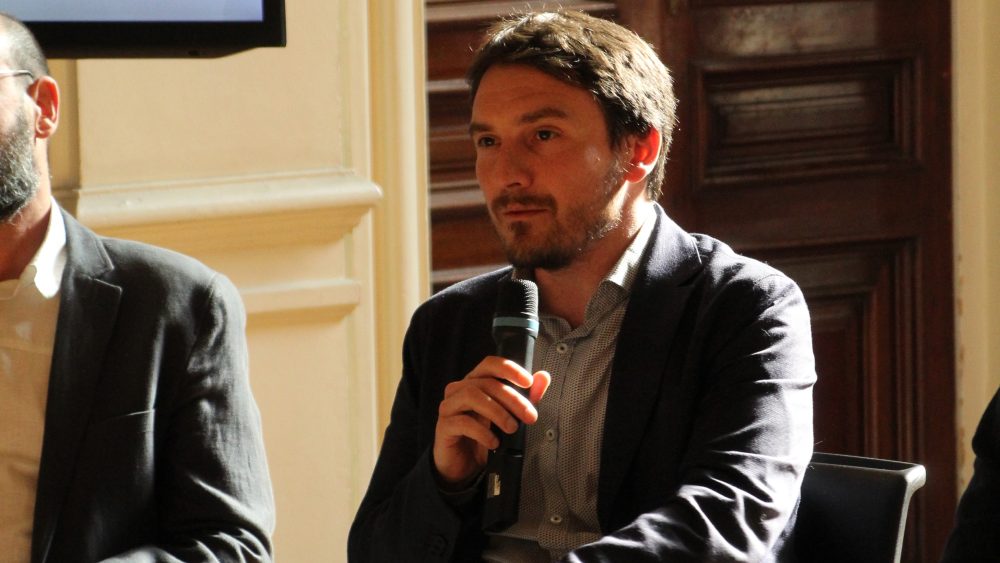
Reflections from Mario’s talk by Oksana Mont
As part of the Post-Growth Business seminar series, we welcomed Mario Pansera in December 2025. Mario Pansera is currently an OPORTUNIUS Research Professor affiliated with the University of Vigo and an affiliated researcher at the Autonomous University of Barcelona. He is Principal Investigator of the ERC Starting Grant project PROSPERA and coordinator of the Horizon 2020 project JUST2CE. Mario is also a member of the Advisory Board of the Post-Growth Business (PGB) project, and we look forward to future exchanges and cross-pollination between PGB and his projects, particularly on innovation, post-growth, and socio-technical change.
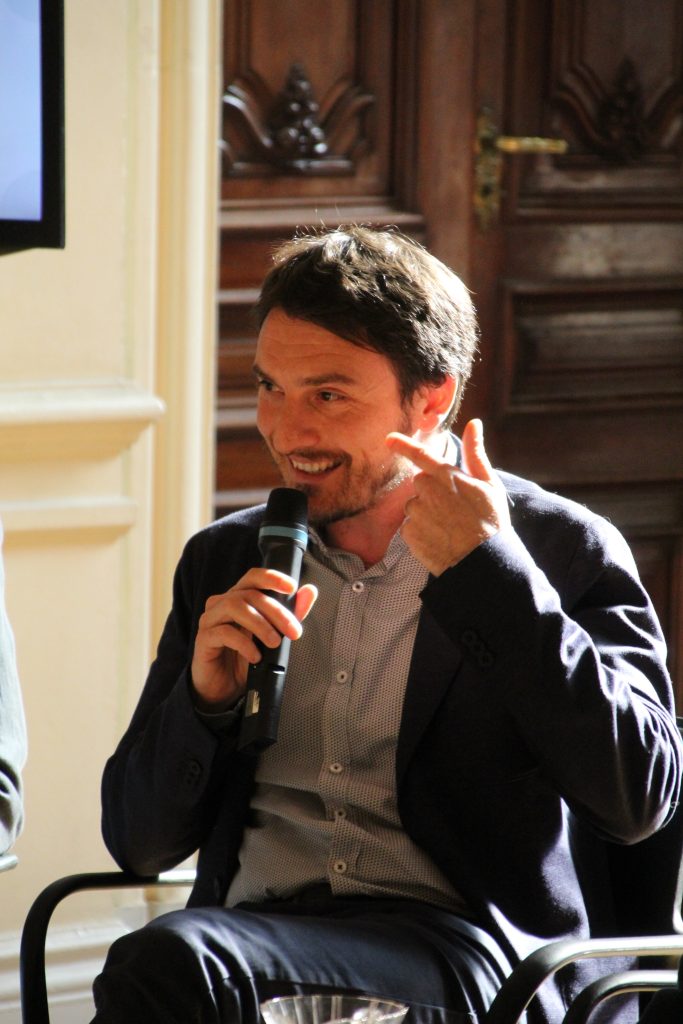
During his talk, Mario challenged one of the most persistent assumptions in sustainability debates: that innovation, if only properly accelerated, will solve our ecological and social crises. Instead, Mario invited us to examine its politics, direction, and distributional consequences. He offered a critical lens on how innovation has become entangled with growth imperatives, technological determinism, and an illusion of control that ultimately undermines both ecological integrity and social justice.
Directed innovation and the politics behind it
Mario began by stressing that innovation is never simply a matter of technical progress. Instead, innovation is directed – shaped by political choices, economic interests, and institutional power. What gets funded, scaled up, or marginalised reflects deeper priorities related to growth, competitiveness, and capital accumulation. This perspective stands in contrast to mainstream narratives that call for “more innovation” as a generic solution. Mario argued that such calls obscure the question that really matters: innovation for what, for whom, and under whose control?
Creative destruction and the growth imperative
Drawing on Joseph Schumpeter’s concept of creative destruction, Mario traced how innovation came to occupy a central role in capitalist growth dynamics. Today, this logic translates into what Mario described as a form of “great destruction” – not merely of firms or sectors, but of ecosystems, livelihoods, and social stability. Productivity gains no longer translate into shared prosperity, as illustrated by the well-documented productivity–pay gap. At the same time, environmental impacts continue to rise, disproportionately driven by the wealthiest segments of society.
Technological determinism and the illusion of control
A recurring theme in the talk was the critique of technological determinism, the belief that technology evolves according to its own internal logic and will inevitably deliver progress. Closely related is what Mario described as “the illusion of control”: the assumption that complex social and ecological crises can be managed through increasingly sophisticated technological systems. This illusion becomes particularly dangerous when technologies are deployed in contexts of violence and domination. Referring to contemporary warfare, Mario highlighted how artificial intelligence is central to the ongoing genocide of Palestinians in Gaza and the West Bank. In such contexts, digital and military technologies are not neutral tools but actively shape and intensify violence, undermining the conditions for life and stripping people of value and agency. The key point was that without social oversight and democratic governance, technological systems tend to reinforce existing power asymmetries and can become instruments of large-scale harm rather than progress.
An alternative framing: conviviality, care, and maintenance
Against this backdrop, Mario proposed an alternative way of thinking about innovation – one rooted in conviviality. Drawing on Ivan Illich and other thinkers, he argued for technologies that support autonomy, care, and collective well-being, which entails rethinking labour and hierarchical organisation of production, valuing care, repair, and maintenance as central economic activities, and questioning the assumption that radical technological breakthroughs are always necessary.
Learning from collective experiments
The latter part of the talk turned to concrete historical and contemporary examples. The Lucas Plan of 1970s Britain illustrated how workers themselves articulated alternative, socially useful production pathways in response to militarisation and job losses. More recent cases, such as worker-recuperated factories, platform cooperatives, and community-led solutions, demonstrate that hybrid value chains and non-capitalist forms of organisation already exist, often in the cracks of dominant economic systems. These examples challenge the notion that post-growth implies stagnation and highlight alternative forms of value creation that better align with social needs and ecological limits, including welfare services, collectively managed infrastructure, and socially useful work.
Rediscovering collective governance Mario closed by situating innovation within a broader political–economic context. Historically, periods of crisis have been followed by strong redistributive policies, including high taxation of wealth and capital. For Mario, the lesson is clear: meaningful innovation for a post-growth society requires rediscovering eco-social policies, collectively managed systems, and democratic control over technology and production. The talk left us with a fundamental question: should we continue to treat innovation as a miracle cure driven by markets and growth, or should we reclaim it as a political and collective endeavour, oriented towards care, sufficiency, and justice?
You can read more in Mario’s open access book: https://bristoluniversitypress.co.uk/post-growth-innovation
