

- Can you briefly explain your research topic and why you chose it?
My thesis is about businesses that put social or ecological purpose ahead of expansion and about whether the institutions around them see and support what they are doing. The setting is Scotland, a founding member of the Wellbeing Economy Governments partnership, described as the only living laboratory at scale in the world where governments test wellbeing economy policy rather than just talk about it. That makes it about as favourable a test case as exists: if the institutional conditions for business beyond growth are good anywhere, they should be good here. So the question becomes a fair one to ask: what does the living laboratory look like from the floor to the enterprises supposedly being enabled by it?
I chose it because post-growth business is one of the most interesting unresolved questions I met at the IIIEE: we know a lot about how firms can be greener; much less about what a firm is for if not expansion. Also, I was curious about the landscape in which businesses operate and which quietly decides which organisations get to exist.

The city of Edinburgh in Scotland (Dominik Rešek, free under unsplash.com license).
- What was your main research question or objective and method to answer it (i.e. your research design)?
The overall aim was to understand how Scotland’s wellbeing economy agenda interacts with the institutional conditions facing SMEs that operate beyond growth. That broke into three questions: how Scotland’s wellbeing economy framework conceptualises the role of business beyond growth; how post-growth-oriented SMEs themselves define and carry out practice beyond growth; and what institutional, financial and market barriers and enablers they encounter.
I have a qualitative multiple-case study with three layers of empirical material: 1) a corpus of 33 Scottish policy and institutional documents, organised into 5 tiers, from the National Performance Framework to enterprise agency operating criteria and advocacy publications; 2) semi-structured interviews with six case SME founders and managers and three intermediaries from enterprise support and advocacy bodies; 3) company-level documents (accounts, constitutions, published reports) for each case. Everything was coded in NVivo using a hybrid scheme (inductive-deductive).
The analytical framework puts two literatures into one space: Scott’s three institutional pillars on one side and Hinton’s post-growth business model dimensions on the other. Frictions and enablers show up where the two cross.
- What were the most important findings or insights from your study??
First would be Scotland’s policy documents that treat the wellbeing economy as growth made fairer, greener and more inclusive; not as an alternative to growth. This is not just timidity – the very fiscal architecture of devolution of the UK functions as a structural growth requirement, and even those who know and oppose growth are constrained by it.
Second would be the fact that Scotland has quite a few enterprises who treat surplus as means rather than an end, are mission-locked, have democratic governance and purposes defined by community, social or ecological benefit and deliberate ceiling on size. They don’t call themselves post-growth. However, they survive in the environment that was not built for such enterprises.
Third would be the fact that frictions these enterprises encounter compound. They are not obstacles tackled one at a time but a knot in which each one makes the next bite harder: the living wage they pay raises their costs, higher costs weaken them in a procurement market where they might have already been excluded because of their limited scale, and there are no metrics to let them argue the point.
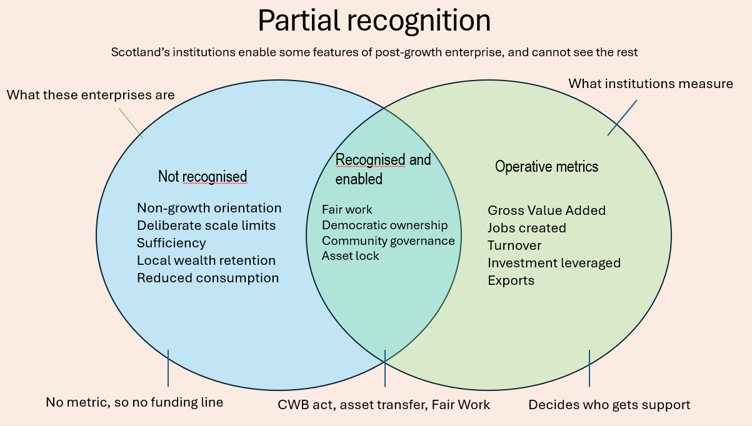
Figure: What institutions in Scotland can and cannot see (Kotrikadze, 2026)
- Did anything surprise you during the research process?
Some policy contradictions in Scotland: the Scottish Government requires contractors to pay the real living wage and prices care-sector contracts too low for that to be possible. Another one, more political: by keeping its procurement rules aligned with the EU in the hope of rejoining, Scotland has ended up with less flexibility to favour social enterprises than post-Brexit England has. So an independence strategy and a social enterprise strategy are pulling against each other.
Another surprising fact I learned was that one of the case companies moved from a more democratic governance to less, under operational pressure. This is the opposite of what the literature tends to assume for post-growth firms. It looks more like a practice that needs enabling conditions: money, time, experience. Take those away and it retreats.
- What implications does your research have for businesses in a post-growth economy?
The main one is that a post-growth business model is not only a design problem, it is a navigation problem. Every one of the case SMEs had built adaptive strategies simply so that the institutions around them could make sense of what they were: translating their work into GVA and job numbers to get attention, inventing their own metrics because no official ones fit, in one case deliberately concealing the social mission behind a conventional business presentation to avoid stigma. That work costs real time, money and emotional energy. Every hour of it is an hour not spent on the missions. It is an invisible tax imposed by institutions that do not know they are imposing it.
Another implication of my research could be that doing the right thing is not currently self-financing and any serious post-growth economy has to have an answer to that.
Third one is perhaps more encouraging. These models are not fragile or marginal. Some of the cases have been around for decades. Maybe they are not visible but they are viable.
- Based on your findings, what would you recommend to practitioners, policymakers, or researchers?
For policymakers, the most concrete opportunity is immediate. The Community Wealth Building (Scotland) Act came into force in March 2026 and Ministers must consult on and issue statutory guidance within eighteen months. That guidance is where sufficiency-oriented and growth independent enterprise could be defined as a recognised institutional category, alongside the democratic and inclusive business models the Act already names. Beyond that: develop a common social value metric framework that the National Performance Framework, Scottish Enterprise, Highlands and Islands Enterprise and other public bodies actually share, so that non-growth contributions becomes countable; revisit the Scottish National Investment Bank’s 1 million floor and commercial-return requirement, which structurally exclude every enterprise in my sample.
For enterprise support bodies: add business model orientation to your assessment criteria, not just growth potential, so that non-scaling firms are routed somewhere rather than falling out of the default pathway. And formalise consortium bidding, so that small enterprises can collectively meet contract scale and insurance thresholds.
For researchers, perhaps, the comparison I could not do in this thesis, namely the same institutional analysis across Wales, Iceland, New Zealand and Finland to see whether partial recognition is a Scottish quirk or the standard WEGo patter (I suspect the latter).
- Looking back, what was the most rewarding aspect of your thesis work?
The interviews. People gave me their time generously and talked with such candour and passion.
- What are you doing now (or what are your future plans)?
I am based in Skåne and moving on from the thesis into work that keeps me close to these questions: sustainability, economic policy, business support or research. If any of that overlaps with what readers are doing, I’d be glad to hear from you.

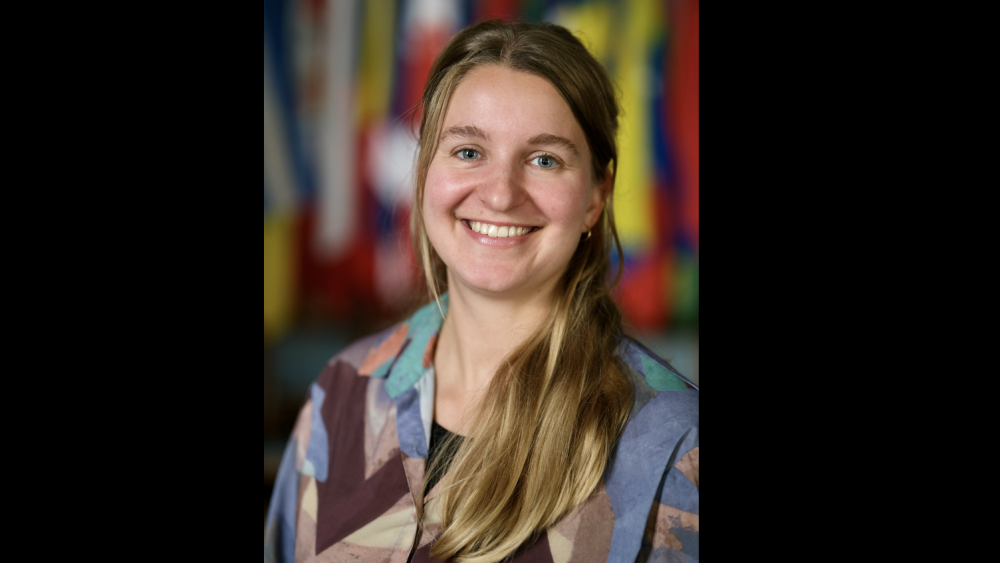
Masters researcher Revaz Kotrikadze









Comments